
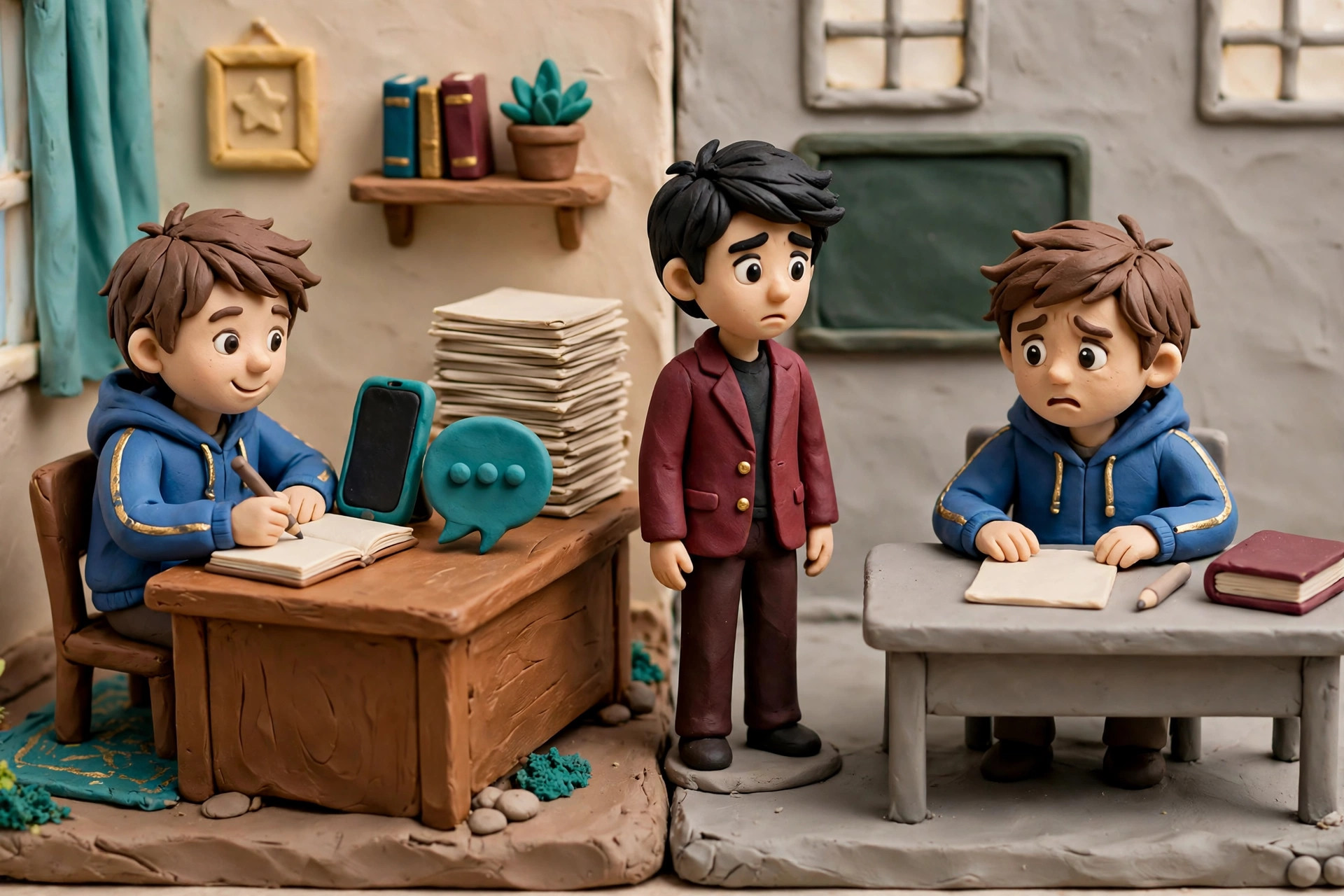
Homework scores up 18%. Exam scores down 20%. That is what happened to 26,811 students who started using generative AI — and it is the clearest warning yet that better homework does not always mean better learning.
The homework got faster and the marks got higher. The learning went the other way.
What the study actually found
The research comes from David Strömberg, Victor Lei and Yanhui Wu (CEPR Discussion Paper 21577, 2026), The Generative AI Learning Penalty: Evidence from Chinese Secondary Education. The team followed 26,811 students in grades 7 to 12 in one county in central China for 30 months, linking weekly homework scores and completion times to monthly closed-book exams and entrance exams across nine subjects.
AI use spread fast. By June 2025, roughly 80% of students reported using generative AI, up from almost none in September 2022. The most popular tools were Doubao and DeepSeek — general-purpose chatbots with no special educational features.
Here are the headline numbers:
- Homework scores rose by 18% after students adopted AI, while the time spent on homework fell by 30% — from about 64 minutes to about 45.
- Monthly closed-book exam scores fell by 20% within six months of adoption.
- On the high-stakes entrance exams, the full penalty took about two years to appear: 24% for high-school entrance exams and 18% for college entrance exams.
- The losses were uneven. Exam scores fell by around 27% in social science subjects such as history and politics, about 22% in STEM, 17% in English and 9% in Chinese. Junior students, boys and previously high-achieving students lost the most — the students we worry about least.
Why homework scores stopped meaning anything
The most unsettling finding is not the size of the drop. It is what happened to homework as a signal.
Among students who did not use AI, the usual pattern held: higher homework scores went with higher exam scores. Among AI users, the relationship flipped — students who scored higher on homework were more likely to do worse on exams. A sudden jump in homework marks is now a warning sign, not good news.
The researchers found two very different ways of using AI, and they led to opposite outcomes. After six months, about four in five AI users were finishing assignments in under 50 minutes — faster than the fastest students without AI — with exceptionally high homework scores and markedly worse exam results. That pattern is consistent with handing much of the homework over to the chatbot.
The remaining one in five kept spending roughly as long on homework as students who did not use AI. Their exam scores were similar to non-users. They were using AI, but they were still doing the thinking.
A randomised trial the authors cite shows the same split. In Turkey, nearly 1,000 high school maths students got GPT-4 tutors. A chatbot giving direct answers improved practice scores by 48%, but when it was taken away those students scored 17% worse on the exam than students who never had it. A version giving hints instead of answers improved practice scores by 127% and largely removed the harm. The students did not think they had learned less.
In my classroom
I teach ICT, Computer Science and Robotics in Bangkok, and I see this exact split every week.
When my Year 7 and 8 students debug a Python program, the ones who paste the error into a chatbot, copy the fixed code and move on cannot explain what the fix did five minutes later. When the same bug comes back in a different program, they are stuck again. The homework looks done. The learning never happened.
It is even clearer in Robotics. A student who lets AI write the whole Arduino sketch for a line-following robot has nothing to fall back on when the robot veers off the track in class. The student who wrote the logic themselves, even with AI help on the syntax, knows exactly which line to check. The robot does not care how good the homework looked. It only cares whether the student understands the code.
Steal this: four routines that keep the learning in the homework
1. Try first, chatbot second. Students must have a proper go at the problem or the first draft before they open a chatbot. The hard thinking has to be theirs.
2. Hints, not answers. Teach students to prompt for a nudge or a question back, not the solution. This is the exact design that protected learning in the Turkish trial: the hint version helped, the answer version harmed.
3. Explain it back, screen closed. Any AI-assisted work must be explainable by the student in their own words, without the chatbot open. Close the chat, explain the idea out loud or on paper, then check where you got stuck.
4. Test without it, and watch the clock. Short closed-book quizzes on homework material show what students actually know. And watch the time: if homework that used to take an hour now takes 15 minutes with perfect marks, the AI is doing the learning for the student. The study's authors suggest the same — look at time actually spent on homework and short in-class quizzes, not homework scores alone.
The honest caveat
This is a discussion paper, not yet a peer-reviewed journal article, and it is not a randomised trial. Students chose when to start using AI, and the researchers compared changes in their results with students who had not yet adopted it — a strong design, but it cannot rule out every difference between the two groups. It also covers teenagers in one county in China, using general-purpose tools on their own, and the authors themselves say the effect sizes cannot be directly applied to other settings.
But the pattern lines up with a randomised trial, with decades of research on desirable difficulties, and with what most teachers are already seeing in their own classrooms. The size may differ elsewhere. The direction is hard to ignore.
The homework is not the learning. It never was. AI just made that obvious, at a cost of 20% on the next exam for the students who let it do the thinking.
When your students hand in perfect homework this week, how will you check whether they actually learned it?
Sources: Strömberg, D., Lei, V. and Wu, Y. (2026), The Generative AI Learning Penalty: Evidence from Chinese Secondary Education, CEPR Discussion Paper 21577 — authors' summary (VoxEU). Also cited: Bastani, H. et al. (2025), "Generative AI without guardrails can harm learning", Proceedings of the National Academy of Sciences 122(26).
Title image: original clay artwork created for this blog.