
The Hour of Code is now the Hour of AI. Code.org renamed itself CodeAI in June, and on November 17 it launched this year's campaign with a new theme, "Start Building" — over 250 free one-hour activities where students build their own game or web app instead of just watching code run.
Computer Science Education Week starts in 11 days, on December 7. If you teach computing, this is your easiest win of the term.
What CodeAI actually launched
The source is CodeAI's own announcement, published November 17, 2026. CodeAI is the nonprofit formerly known as Code.org, and the Hour of AI is the renamed Hour of Code — the same one-hour, no-experience-needed format, now pointed at helping students understand how AI works.
This year's catalog holds over 250 short activities developed by organizations including NASA, LEGO Education, Common Sense Media and BrainPOP. Two new activities lead the campaign:
- Quest Builder (Grades 3–8): students build their own game from scratch — the images, the world, and the code. For the images, they choose whether to draw by hand or use AI, and they can change anything the AI makes until it fits. They finish with a game they built themselves and can play.
- AI Makerspace (Grades 9–12): students build a web application around something they care about, with AI as a co-creator. Along the way, they learn to prompt and work with AI, and new skills unlock as their work progresses. The result is a real project on a topic that is personal to them and ready to share.
OpenAI is the presenting sponsor of Hour of AI 2026. And for teachers, CodeAI built a free 30-minute professional learning course with Microsoft Elevate that prepares teachers with little or no AI experience to lead an introductory conversation about AI. Teachers who complete it earn an Hour of AI Educator credential.
The scale is hard to ignore. CodeAI says 36.8 million learners took part in the Hour of AI in 2025–26, and the organization has reached more than 155 million students across 190 countries.
Why it matters: students are already using AI
Here is the number that explains the whole rebrand. When Code.org became CodeAI on June 2, 2026, it released survey data showing 84% of US students report using AI, but only 16% of high school leaders say all their students are learning about AI in school. Students are using the technology. Schools are mostly not teaching it.
CodeAI president and CEO Karim Meghji put it plainly in the launch announcement: "Parents and teachers are right to have questions about AI. But students are already using it, whether or not schools teach about it."
That is the gap the Hour of AI is built to close. The old Hour of Code proved a student could finish a coding puzzle in an hour. The new Hour of AI asks a harder question: can a student make something of their own, and can they tell when the AI's help is wrong?
Notice the detail in Quest Builder. Students do not just accept what the AI draws — they can change anything it makes until it fits their game. That is the skill that matters most right now: treating AI output as a first draft, not a final answer. A student who learns to push back on an AI-generated image at age 10 will push back on an AI-generated essay at age 16.
Do not mistake it for a coding event. CodeAI says the conversation starts with AI, but what students actually learn is the digital sciences — computer science, data science and AI science. The hour is a doorway, not a course.
In my classroom
I teach ICT, Computer Science and Robotics in Bangkok, and I have run an Hour of Code every December since I started teaching. The old format worked: one hour, one activity, every student finished something. But the students had followed steps. They had not made a decision.
This year I am changing the plan. My Year 5 and 6 classes fall on Monday and Wednesday under our new timetable, and Computer Science Education Week runs December 7–13 — so my Monday Year 5 and 6 lesson is the natural slot. Instead of a guided puzzle, I am running Quest Builder with them. Each student builds their own game, and my one rule will be the same one CodeAI built into the activity: if the AI draws something, you are allowed to change it, and you have to be able to say why you changed it.
One practical note for teachers in Thailand: the activities are free, they run in a browser, and the catalog is available in multiple languages.
Steal this: run your Hour of AI in December
Here is my plan, in the order I will actually do it:
- Pick one activity this week (10 minutes). Go to hourofai.org/activities and filter by your students' grade. For primary, pick Quest Builder. For secondary, pick AI Makerspace. Do not browse the whole catalog — one activity, decided now.
- Do the 30-minute teacher course (30 minutes). It is free, from CodeAI and Microsoft Elevate, and it earns you the Hour of AI Educator credential. Do it the week before, not the morning of.
- Try the activity yourself first (one hour). Build the game. See where students will get stuck.
- Set the "change it" rule before you start. Tell students: anything the AI makes, you can change, and you should be able to say why. That one sentence turns a demo into a lesson.
- End with a show-and-tell, not a score. Five minutes. Two or three students show what they built and name one thing they changed from what the AI first gave them. That answer is the whole point of the hour.
- Point to what comes next. The Hour of AI is a first step, not a full course. If a student wants more, CodeAI's longer units build directly on the activity — that is your follow-up lesson already written.
The honest caveat
One hour is one hour. No student becomes AI-literate in 60 minutes, and a single activity will not fix a curriculum that never mentions AI again. The participation numbers are CodeAI's own figures, and the 84% student-use figure comes from a US survey, so it describes American classrooms, not Bangkok ones. Treat the Hour of AI as what it says it is: a first step.
Still, a first step that 36.8 million learners took last year is a good place to begin. The Hour of Code taught a generation that they could code. The Hour of AI is teaching the next one that they can build — and that they are allowed to argue with the machine while they do it.
Will you run an Hour of AI with your class in December — and if you do, what will your students build?
Sources: CodeAI (formerly Code.org), Start Building: Hour of AI Gives Students a Hands-On First Step Into Understanding Technology (November 17, 2026) — code.org. Also cited: CodeAI, The Hour of AI — code.org (36.8 million learners in 2025–26; 250+ activities); CodeAI, Code.org becomes CodeAI (June 2, 2026) — code.org (84% of US students use AI; 16% of high school leaders say all their students are learning about AI). Activities: hourofai.org/activities.
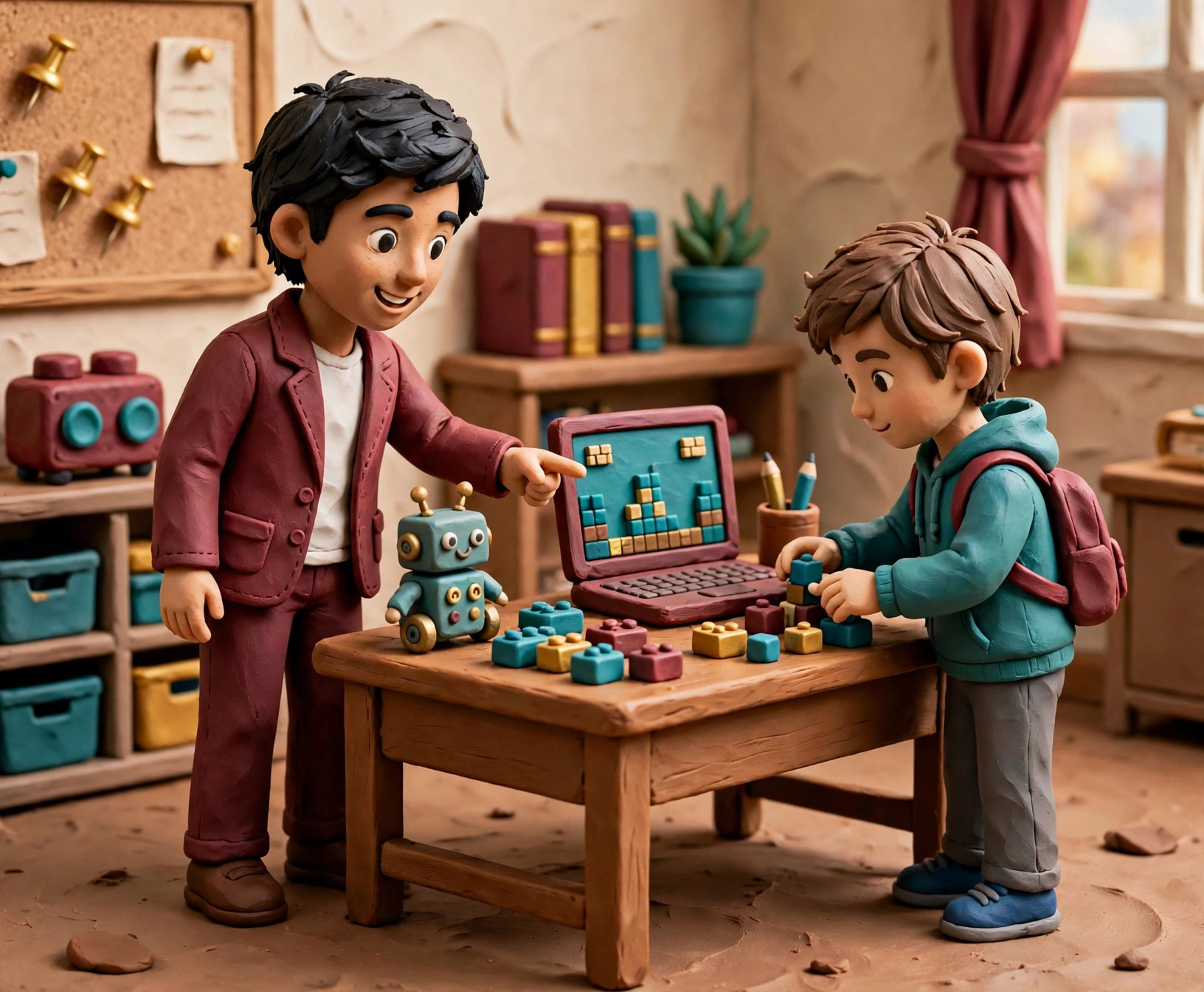
Title image: original clay artwork created for this blog.