
Stanford just reviewed 52 rigorous studies on AI in schools — and the verdict comes down to one rule. When students use AI to understand something, they tend to learn more. When they use it to produce work for them, they tend to learn less. Same tool, opposite results, and the difference is how the student uses it.
The review comes from Stanford's SCALE Initiative, published November 10, 2026. It is the biggest causal evidence check on AI in education so far.
What Stanford actually found
The review is called The Evidence Base on AI in K-12: A November 2026 Review, and it only counts causal studies — randomized controlled trials and well-designed quasi-experiments, not surveys or vendor white papers. In March 2026, the same team found 20 papers strong enough to include. This update adds 32 new papers, published between October 2025 and June 2026, bringing the total to 52.
Of the 32 new studies, 28 looked at student-facing AI tools and 4 looked at educator-facing tools. For the first time, 5 of the new student-facing studies were conducted in real US K-12 schools — the March review had none. Most of the new evidence on academic outcomes focused on science and computer science, which grew from 3 papers to 16, while studies on social-emotional outcomes grew from 3 to 11.
The headline finding is the split between two kinds of use. The review defines them plainly: AI for learning support means students use AI to learn new material or guide their thinking; AI for producing work means students use AI to draft essay text or complete homework problems for them. Learning support shows mixed but more favorable results. Producing work can actively reduce learning.
The examples are hard to argue with. In one study, Brazilian undergraduates used AI to finish a presentation faster — then scored worse on a surprise conceptual test afterwards. In another, Canadian beginners who had AI generate complete coding solutions did well on the coding task but showed limited understanding of the solution or the concepts behind it. On an adaptive math platform in the US, after ChatGPT was released, students spent less time on text-based practice problems that were easy to paste into a chatbot — and then performed worse on those same kinds of problems on proctored tests, where AI was not available. And in a study of US college students, essays written with AI help were better while AI was available, but the advantage disappeared completely on a later essay written without it.
The other side of the split is more hopeful. When students used chatbots to learn unfamiliar material — to explain concepts and deepen understanding — they performed better on tests taken without AI, and in some US studies those gains were still there on follow-up tests three days to one week later. Students also learned the most when they had stronger skills in prompting, filtering and checking what the machine produced. Knowing how to question the answer turns out to be part of the learning itself.
Why it matters: the feel-good trap
Here is the part of the review every teacher should read twice. AI tools can improve students' learning experiences even when they do not improve learning outcomes. Students in several studies reported that AI made the work feel easier and the feedback clearer — while their test scores did not move at all. A tool can feel like it is working and still not be teaching anything.
That is the trap I see in my own classroom. A student pastes an error message into a chatbot, gets working code back in seconds, and feels brilliant. Then the next lesson asks them to write a similar loop from scratch, and the confidence evaporates. The feeling of learning and the fact of learning are two different things, and AI is very good at producing the first one.
The review has a warning for teachers too. AI can save real time on lesson planning without lowering quality, and teachers given AI feedback drafts gave students more and higher-quality feedback without spending more time. But one new study found that giving teachers an AI support tool reduced students' motivation and confidence. The tool does not replace the teacher's judgment. When it starts to, students notice — and they disengage.
So the rule is not "ban AI" and it is not "let students use it freely." It is: AI is a tutor, not a ghostwriter. Use it to explain, to question, to practice. Never to hand in.
In my classroom
I teach ICT, Computer Science and Robotics in Bangkok, and my Year 7 and 8 CS classes meet on Mondays and Fridays. This term I have made the Stanford rule explicit, in words my students can repeat back to me: ask the AI to explain it, then close the laptop and do it yourself.
It plays out in small, concrete ways. When a Year 8 student hits a bug in their Python project, they are allowed to ask the chatbot what the error message means — but they have to explain the fix to me in their own words before they type it. The AI is the explanation. The student is the builder.
Steal this: the explain-first rule for your class
Here is the routine I use, in the order I actually run it:
- Say the rule out loud on day one. "AI explains. You do the work." Put it on the board. Make it the only AI rule your students need to remember.
- Teach one good prompt. "Explain this like I am 12, then ask me one question to check I understood." That single prompt turns a chatbot into a tutor instead of an answer machine.
- Require the explanation back. Before a student uses an AI fix, they tell you — or a classmate — what the fix does and why it works. If they cannot explain it, they have not learned it yet.
- Make AI checkable, not invisible. Homework that could be pasted into a chatbot gets a short in-class follow-up: two questions, no devices, five minutes.
The honest caveat
Fifty-two studies sounds like a lot, and it is a big step up from twenty. But the review is honest about what it cannot say yet. Most of the evidence still comes from postsecondary settings, not K-12 — only five of the new student studies were in US K-12 schools. Much of the repository is preprints that have not been peer-reviewed. And almost nothing in the review shows whether learning gains last beyond a few days or weeks. The rule is the best current evidence, not the final word.
Still, this is the clearest picture we have ever had of what AI does in real classrooms — and it points the same way as the last three studies I have covered here. The tool is not the teacher. The student doing the thinking is.
Do you have an "explain first" rule in your classroom — and what happens when you take the AI away and ask students to do it alone?
Sources: Walker, Fesler, Martinez Claeys, Agnew & Loeb (2026), The Evidence Base on AI in K-12: A November 2026 Review, SCALE Initiative at Stanford University — scale.stanford.edu (DOI: 10.26300/80wn-ca81). Also cited in the review: Contractor & Reyes (2026); Anand & Idan (2026); Heldreth et al. (2026); Oreopoulos et al. (2026); Rismanchian et al. (2026); Barcaui (2025); Chen et al. (2026).
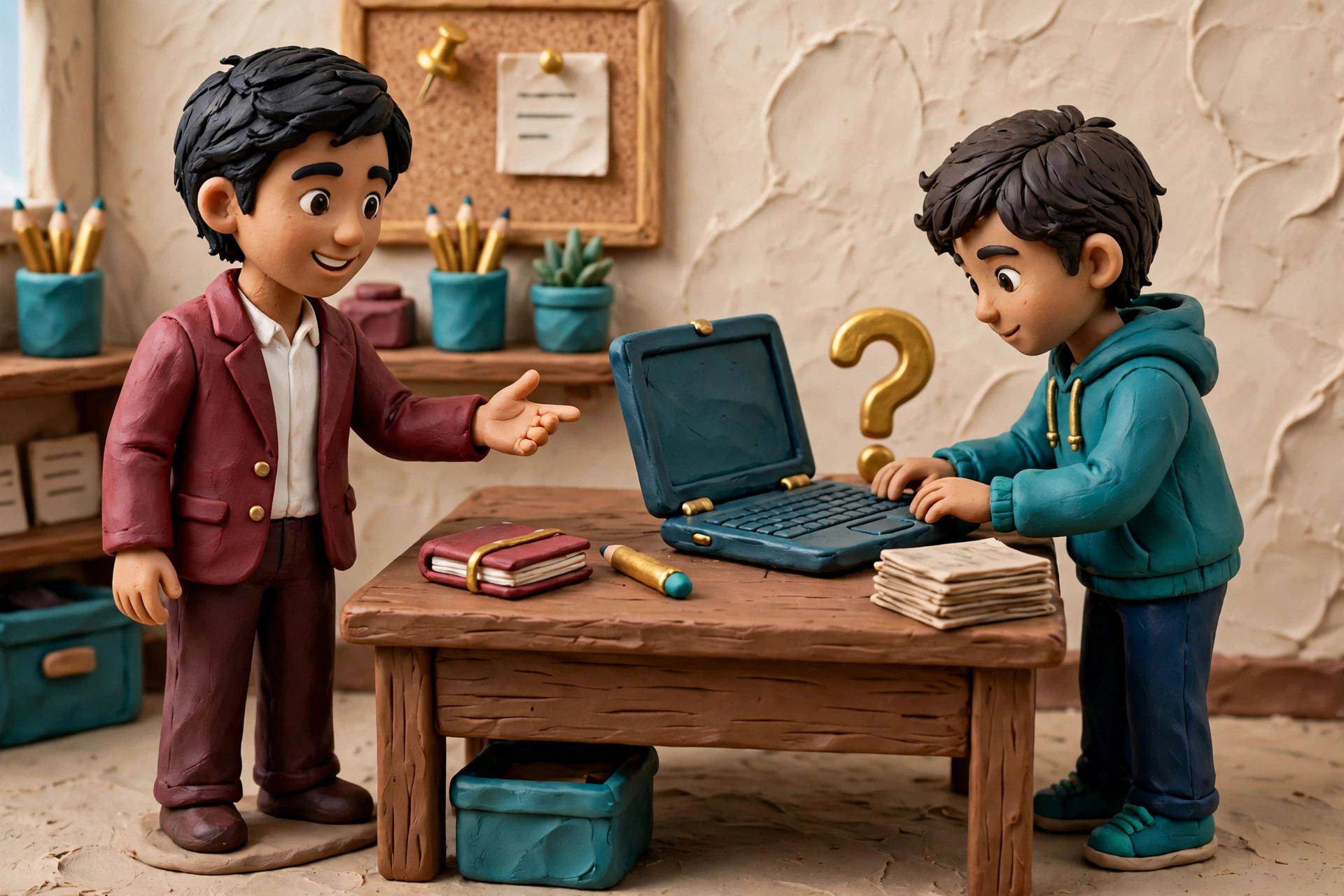
Title image: original clay artwork created for this blog.